After representing Canada internationally, including on the Olympic stage, Oral O’Gilvie never imagined his greatest challenge would come on a golf course.
Recognizing the early signs and acting ‘FAST’ can be what saves a life, or dramatically improves recovery, after stroke.
For Oral O’Gilvie, an elite level athlete, both of these factors made a critical difference when he experienced a stroke in May 2024 after an ordinary day of golf took a sudden and unexpected turn.
The “FAST” acronym is a simple way to remember the signs of stroke: Face drooping, Arm weakness, Speech difficulty, Time to call 9-1-1.
Fortunately, Oral’s golf partner was familiar with these signs, and when he began to slur his speech, Oral was quickly rushed to an acute care facility for further assessment and care.
In a situation as critical as Oral’s, time was of the essence, and for Oral, time was certainly on his side. Within just 45 minutes of his stroke, Oral arrived at the hospital where a CT scan confirmed a clot on the right side of his brain; a clot-busting medication was quickly administered.
The next morning, Oral woke up unable to move or feel the entire left side of his body. Just a day later, he was assessed for the Glenrose Rehabilitation Hospital and admitted shortly after to the inpatient stroke recovery unit.
“When I arrived, I needed two people to help me do anything — walk, shower, use the washroom,” Oral recalled. “But within days, I was up and walking with a cane. At first, I didn’t even want to call it walking. It felt like I was struggling. But the next day, I felt a little stronger. The harder I worked, the faster I started to see things happening.”
For Oral, it felt like being back on a national team training camp. “I had all the support staff ready to make me compete. Everyone from the cleaning team to physical therapists, occupational therapists, speech-language pathologists, and recreation therapists encouraged me to get back to my normal.”
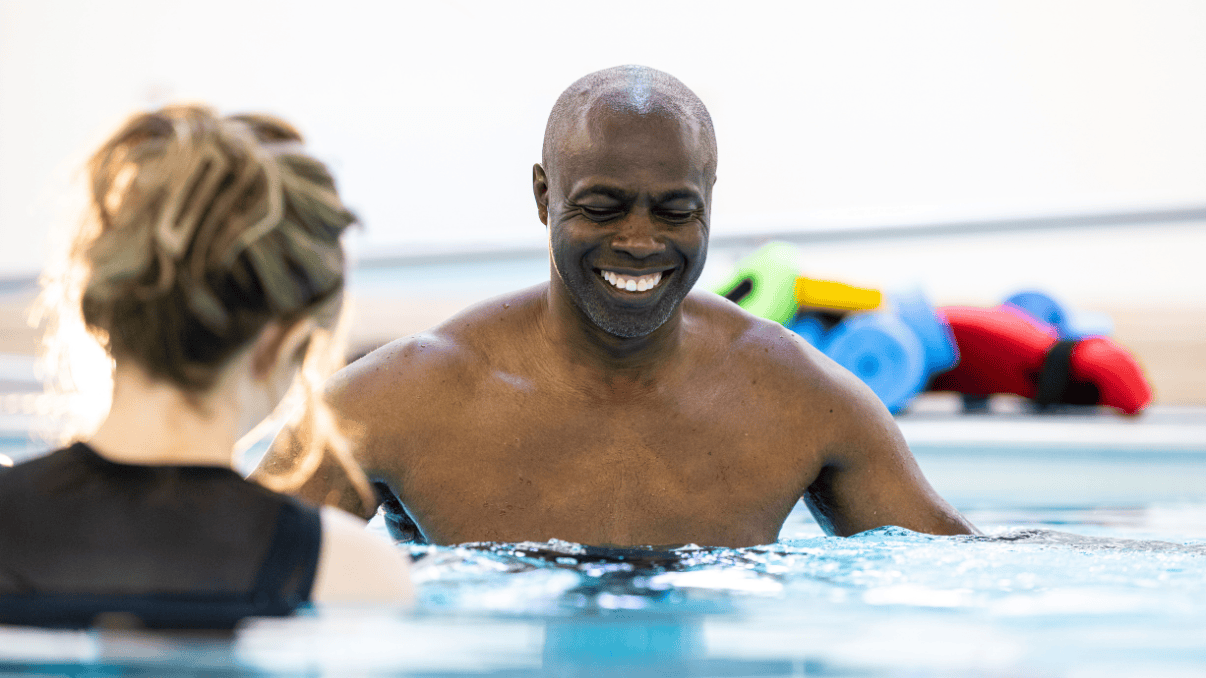
One of his favourite places for therapy was the hospital’s therapeutic pool.
As Oral describes, the water was one place where he was able to stand up and walk with ease. “Because you’re not carrying your full body weight, you have the ability to try a bit more in the pool. You’re not being fully impacted by gravity,” he shares.
He tried to use the pool as often as he could, sometimes three or four times a week, doing anything he could to get his limbs moving. Supported by his therapists, he practiced walking and running with water weights — forwards and backwards — and side shuffling. His biggest challenge was regaining movement in his upper extremities, but with the support of the water, he was even able to get his right arm moving.
“The pool helped me get to a place of independence a lot faster.”
Just four weeks after his admission, Oral walked out of the Glenrose on his own, without assistance. Regaining independence, even in the smallest task, was a powerful turning point.
“Anything that I couldn’t do the day before, is an opportunity to be thankful. A flicker on my arm or leg, I was thankful and excited about.”
And Oral’s recovery continued. Just two weeks after being discharged, Oral returned to the Glenrose as an outpatient continuing with recreational therapy that included golf, yoga, and pickleball. By fall, he had even regained his driver’s license.
Reflecting on his time at the Glenrose, Oral says it’s been life changing. “I recognize that I’m a beneficiary of a world-class facility in Edmonton. I don’t know if I would be anywhere near where I am if I didn’t have access to the facilities and people at the Glenrose. It’s incredible. Absolutely incredible.”
If you or anyone you know is showing the signs or symptoms of stroke—Face drooping, Arm weakness, Speech difficulty—it’s Time to call for help. Acting FAST can make all the difference in stroke recovery.