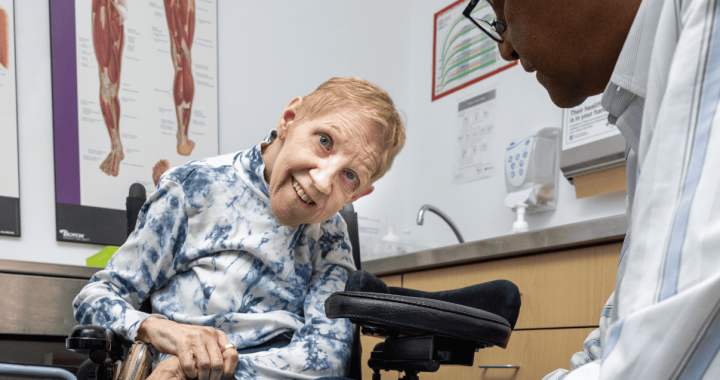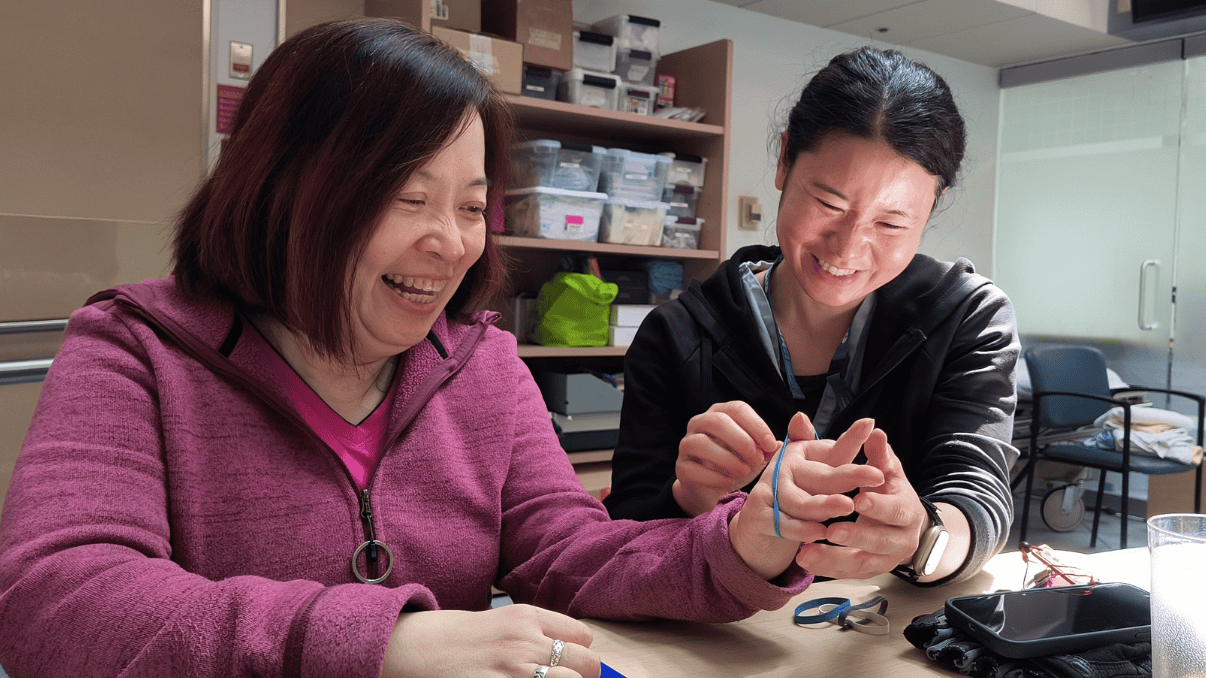
After separate accidents left them with incomplete spinal cord injuries, Kuen and Vicky joined a clinical trial at the Glenrose Rehabilitation Hospital testing two different stimulation therapies designed to help the nervous system relearn movement and restore arm and hand function.
Kuen and Vicky’s journeys began in very different moments, each shaped by a sudden, life-changing event.
In 2001, Kuen’s life changed after a serious car accident caused an incomplete spinal cord injury, leaving her paralyzed from the chest down.
Vicky’s injury came just as unexpectedly when she was struck by a car while crossing the street. Like Kuen, she also sustained an incomplete spinal cord injury.
“In the beginning, everything felt uncertain. Even the smallest movements were difficult,” Vicky says.
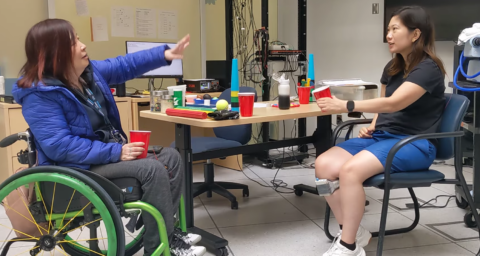 In the months that followed, both began rehabilitation at the Glenrose, working through long, demanding days focused on rebuilding strength, relearning movement, and adjusting to a new way of life.
While they both made progress, one challenge remained especially difficult: movement in their hands.
For many people living with a spinal cord injury, everyday movements like gripping, pinching and holding are some of the most complex to regain.
That’s what led Kuen and Vicky to take part in a clinical trial at the Glenrose, led by Dr. Jessica D’Amico and her research team. The study explores how different forms of stimulation can be paired with rehabilitation to help the nervous system rebuild connections needed for movement.
“In this study, we are hoping to figure out what types of neurostimulation can effectively improve arm and hand function and which approach is best for each individual. Specifically, we are comparing spinal stimulation over the neck region against paired brain and nerve stimulation — both approaches have been shown to be effective in this patient group when coupled with rehabilitation. Ultimately, we want to identify clinical or neural biomarkers that might allow us to predict which individuals will benefit most from one therapy over another; helping us move toward a personalized or precision-based approach to neuromodulation so that we can optimize recovery after injury,” says Dr. D’Amico.
In the first phase of the study, Kuen participated in transcutaneous spinal stimulation (TSS), where small electrical pulses were applied to her neck while she practiced movements. The stimulation stayed on throughout her exercises as she worked through tasks like grasping, lifting, and releasing.
Over time, she began to notice changes. Her grip grew stronger and then one day, after years without movement, her thumb moved.
“I looked down and saw my thumb move. I focused on it, and it opened. My pinkie finger started moving too,” Kuen says.
For Vicky, changes became noticeable as she took part in sessions that combined brain and nerve stimulation followed by targeted rehabilitation. Slowly, she began to regain control in her hands.
“I can pinch now and have better hand control,” Vicky shares. “It helps a lot with my daily life.”
For Kuen, it’s being able to do things she once thought she couldn’t anymore.
“I still notice the small improvements,” she says. “And each one reminds me that there’s still more I can regain.”
For Vicky, a chef, it’s getting back into the kitchen — even something as simple as being able to flip an egg again.
“Being back in the kitchen, even in small ways, feels like getting a part of myself back,” Vicky says.
These stories reflect the larger impact this research can have in helping patients regain independence and reconnect with daily life.
As shared by Dr. Jessica D’Amico, “Research in spinal cord injury rehabilitation is entering a transformative period where we are beginning to better understand how to harness the nervous system’s remaining connections to support recovery. Studies like this are helping us move toward more personalized rehabilitation approaches, where therapies can be tailored to the unique needs and neural state of each individual. Our long-term goal is to develop interventions that translate into meaningful improvements in daily function, independence, and participation in everyday life.”
As studies like this continue, they help move rehabilitation forward.
This study was made possible through joint funding support from the Praxis Spinal Cord Institute and the Glenrose Hospital Foundation, whose investments in clinical research and innovation are helping accelerate the development and evaluation of emerging neurorehabilitation therapies for people living with spinal cord injury.