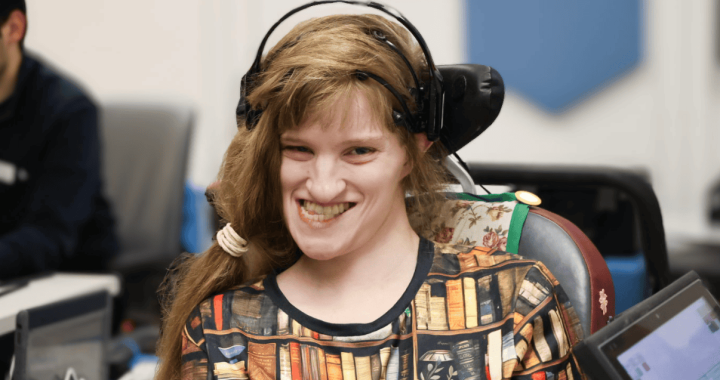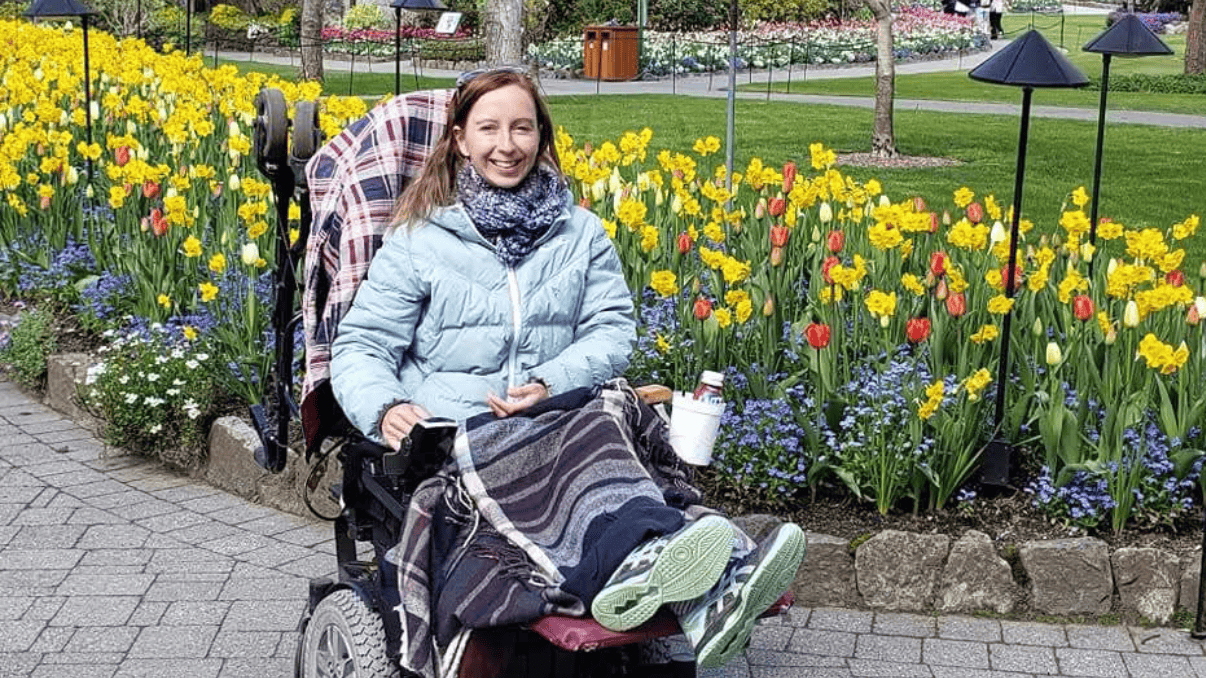
An ‘02 physical therapy graduate from the University of Alberta, devoted wife, and proud mother of four, she moves through the world with grace, all while navigating a complex disability that affects her ability to use her natural voice.
What many don’t realize until that first “hello” is that Jenna uses an augmentative and alternative communication (AAC) device. Much like a touchpad with a keyboard, her device translates text into spoken words. The voice is steady and clear, and as Jenna describes, somewhat “robotic”. But the person behind it is very much human.
What is even less known is what life looked like for Jenna before AAC.
In the early 2000s, while completing a physiotherapy student placement at the Glenrose Rehabilitation Hospital, Jenna toured the I CAN Centre for Assistive Technology. She remembers being struck by its many emerging technologies — tools that opened new doors for people who needed alternative ways to express themselves, to connect, and to be heard.
At the time, she couldn’t have known how personally meaningful that visit would one day become.
“I was voiceless,” she said of that time.
Communication was a daily obstacle. Conversations were written by hand, page after page, across notebooks or scraps of paper that travelled everywhere with her. Each interaction required planning and patience, and while communication was possible, it was limiting and often deeply isolating.
After years of facing her own communications challenges, Jenna wondered if the I CAN Centre could help her.
Eighteen long months later when the call finally came, everything changed.
“That day was the very beginning of a revolution not just in my communication abilities, but in my ability to live my life,” she says. “That’s because communication isn’t done in a vacuum — it’s a doorway that opens up the ability for a person to live their life well on their own terms.”
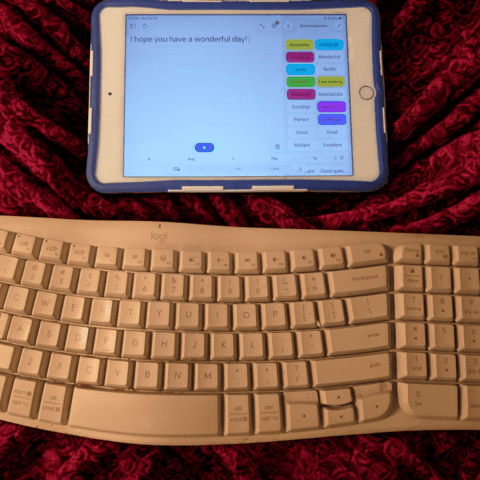
Her clinicians worked alongside her, making sure the technology fit seamlessly into her daily routines and aspirations. And the impact was immediate.
AAC didn’t just give Jenna a voice, it gave her access. To relationships, to contribution, and to choice.
With her AAC system, she began volunteering with organizations that support refugees and newcomers to Canada, eventually leading English conversation classes. She discovered that her clear, synthesized voice was uniquely effective for English language learners, both free of accents and easy to understand.
She joined advocacy committees, participated fully in meetings, and re-entered academic spaces, able to ask questions and engage alongside her peers. And she resumed work as a writer and editor, using communication as a tool to connect with others across all mediums.
At home, AAC transformed everyday moments: coffee with friends and family gatherings. Moments where she no longer was a silent observer, but an active participant.
But perhaps the most important was the impact of AAC on her role as a mother.
With the support of her AAC voice, she and her husband navigated the complexities of the adoption process, meeting with social workers, educators, and medical professionals as equal partners. Today, she is the mother of four children, advocating for them in classrooms and hospitals, communicating with teachers and specialists, and modeling for her children that difference is not something to hide, but something to embrace.
“To my kids, I’m just a mom,” Jenna shares. “Love is what matters.”
In recognition of her extraordinary perseverance and positive outlook, Jenna was recognized with the Glenrose Hospital Foundation 2022 Courage Award, a fitting tribute for her journey.
Yet she is quick to redirect praise.
She credits the I CAN Centre, its therapists, clinicians, and staff, for believing in what communication can unlock. For seeing beyond a diagnosis to a whole person with ambitions and a life ahead of them.
“Life changing is the best way to describe how the I CAN Centre and its staff have impacted my life,” shares Jenna. “My life has much much more colour and ability because of them and I will be forever grateful.
Today, Jenna continues to speak, in classrooms, in boardrooms, and sometimes just across the dinner table, reminding everyone around her that communication is far more than spoken words. It’s about connection.