A clinical trial at the Glenrose Rehabilitation Hospital is exploring how targeted noninvasive spinal stimulation paired with rehabilitation could help the nervous system reconnect after stroke.
Recovery after a stroke often comes in small steps.
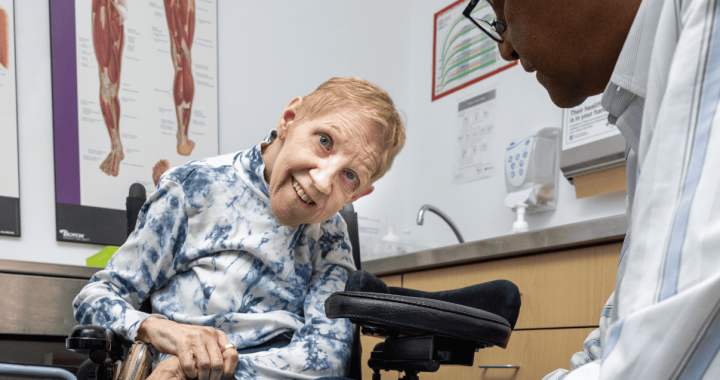
For Darrel and Glen, those steps led them to an innovative research study exploring new ways to restore movement after stroke.
Both men experienced life-altering strokes that affected the left side of their bodies. Walking again came with time and therapy. But regaining movement in their arms and hands was far more difficult.
“It’s better than zero now,” Glen says of his left arm. “But that’s still the biggest deficit.”
For many stroke survivors, hand and arm function can be the hardest movement to regain. That challenge is what led Darrel and Glen to participate in a clinical trial led by Dr. Jessica D’Amico and her research team at the Glenrose, which explores how electrical stimulation of the nervous system may help strengthen the brain and spinal cord connections needed for movement.
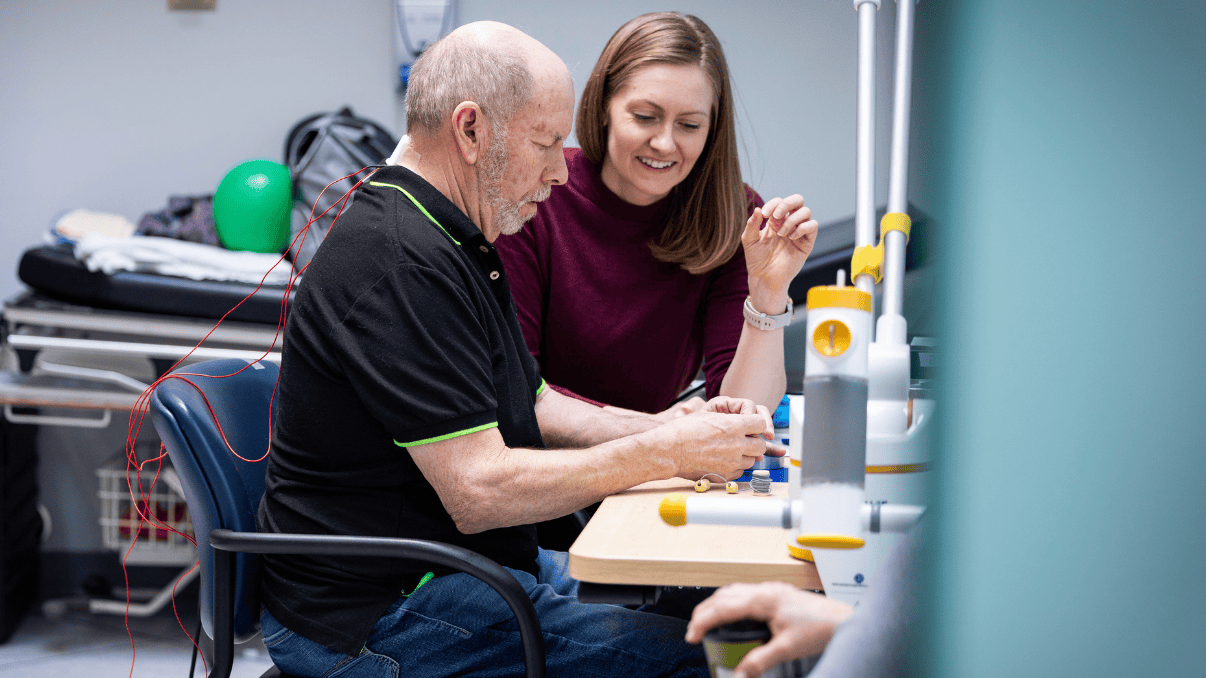
The study pairs targeted rehabilitation exercises with gentle electrical stimulation applied through the skin along the neck and over the spinal cord. The goal is to activate the networks responsible for movement in the arms and hands.
“After a stroke, the signals for movement are very weakened and can’t get through as effectively as they once did,” says Jessica, scientific program lead. “By applying gentle electrical stimulation to the spinal cord and brain while patients practice movement, we’re helping reawaken those pathways and strengthen the communication between the brain, spinal cord, and muscles.”
Participants attend sessions three times a week over eight weeks, completing a total of 24 rehabilitation sessions combined with stimulation. During those sessions, they perform repeated exercises designed to retrain the brain and body to work together again.
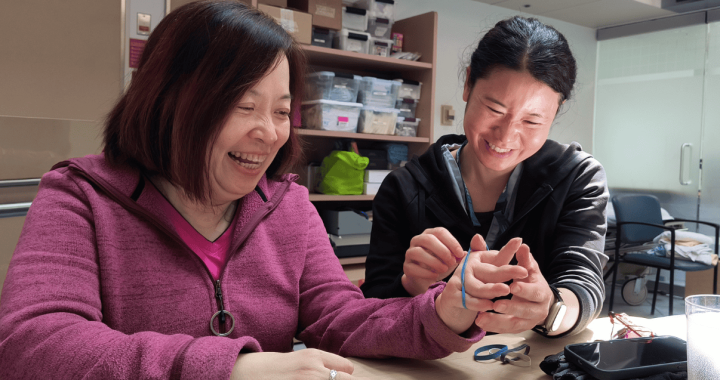
The activities can look simple — catching tennis balls, picking up marbles, stacking small blocks — but each movement is designed to help rebuild weakened connections.
For Darrel, the changes were noticeable sooner than he expected.
“Pretty much right away I noticed I could catch better,” he says. “I could pick up the marbles and stack the blocks.”
Those improvements reflect a process known as neuroplasticity, where repeated activity strengthens damaged pathways in the nervous system, helping restore function.
“What makes this approach powerful is the combination of stimulation with repetitive, task-based therapy,” Jessica shares. “When patients practice meaningful movements while these networks are activated, the nervous system can begin to reorganize and strengthen those connections, which may lead to lasting improvements in function.”
Glen saw similar progress. When he began the trial, movement in his left hand was extremely limited. Over time, he began to regain control.
“I can now open and close my hand,” he says. “And I can pick up something like an M&M between my thumb and forefinger.”
For Glen, that small movement represents a major milestone.
“That’s a huge change.”
The current study is part of a growing effort to develop new rehabilitation tools for people living with stroke and spinal cord injuries. Early results are helping researchers explore how stimulation therapies could eventually become more widely available, including the possibility of future home-based systems that allow patients to continue therapy in their own communities.
“We’re still in the early stages, but the goal is to develop therapies that could eventually be delivered more broadly, including in people’s homes,” says Jessica. “If we can pair technologies like stimulation with structured rehabilitation outside the hospital, it could dramatically expand access to recovery for stroke survivors.”
For the researchers leading the work, none of these discoveries would be possible without the participants who volunteer their time and effort.
“Every breakthrough in rehabilitation begins with people who are willing to take part in research. The individuals in this study are not only working toward their own recovery; they are helping us discover new ways to restore movement for thousands of stroke survivors in the future,” says Jessica.
For Darrel and Glen, participating in the study has meant being part of something larger than their own recovery.
“There’s a group of us that started around the same time,” Glen says. “We’re all rooting for each other. We celebrate the small wins.”
And sometimes, those small wins mean everything.