Four years ago, a mysterious illness crept up the body of then-sixty-year-old physician Dr. Rob Agostinis, stealing his ability to speak, breathe, and move. Perfectly healthy the day before, he was suddenly paralyzed from the jaw down.
In September of 2021, Dr. Agostinis travelled to Cranbrook, British Columbia, to visit his mother. After a routine workout, he noticed an unusual weakness in his legs and went to the emergency room. Sent home without answers, he awoke later to a rapidly worsening weakness and dialed 911.
Months of testing finally revealed the cause: he had anti-neurofascin syndrome, an extremely rare autoimmune condition in which antibodies attack the junctions between the nerves. His case was so uncommon that he was told he was only the 17th documented case in the world, and that the first 16 had not survived.
“My world just shattered right there in a minute,” he recalls.
After months in acute care and intensive treatment, Dr. Agostinis was finally well enough to transfer to the Glenrose Rehabilitation Hospital. His recovery from that point was nothing short of remarkable.
When he arrived at the Glenrose, he had regained his voice and some upper-body movement, but nearly every part of daily life still needed to be relearned.
“I was determined,” he says. “I wanted all the therapy I could get.”

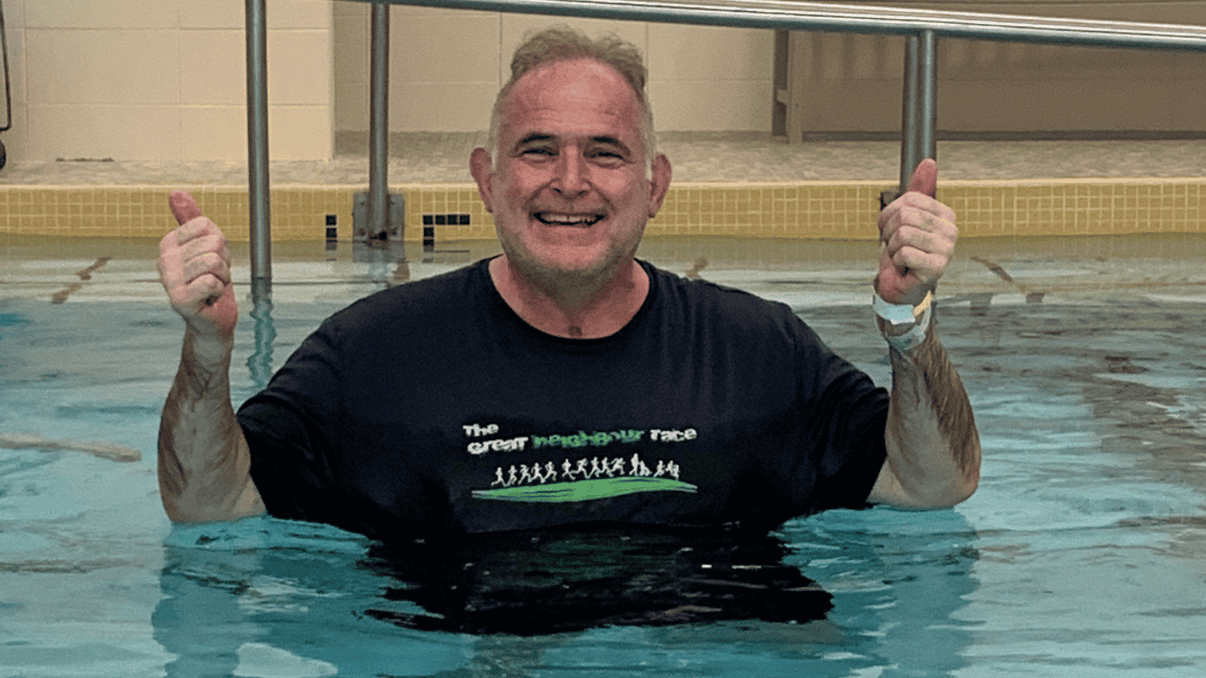
“The pool was so much fun. I loved the pool,” he says.
In the water, his body came alive. Muscles that felt frozen before suddenly responded. The buoyancy and weightlessness of the water allowed him greater ease of movement, and in those early sessions, he used the pool to walk laps and float — simple motions that felt like meaningful victories. Movements that were impossible in his usual therapy sessions became possible in the pool.
“Aquatic therapy is so important. It relaxes your muscles, lifts your mood, and lets you move in ways that aren’t possible on land. It should be part of everyone’s rehab.”
He began with 15-minute sessions and gradually worked his way up to an hour. The physical progress was remarkable, but the emotional reprieve mattered just as much. The pool gave him hope and the confidence to say, “I can do this.”
In February of 2022, Dr. Agostinis walked out of the Glenrose using a four-wheel walker. Two weeks later, he began outpatient therapy.
Today, he wants others to feel the same confidence and possibility that the Glenrose gave him, and your support makes that possible. This holiday season, help expand access to complex rehabilitation therapies at the Glenrose with a gift today.